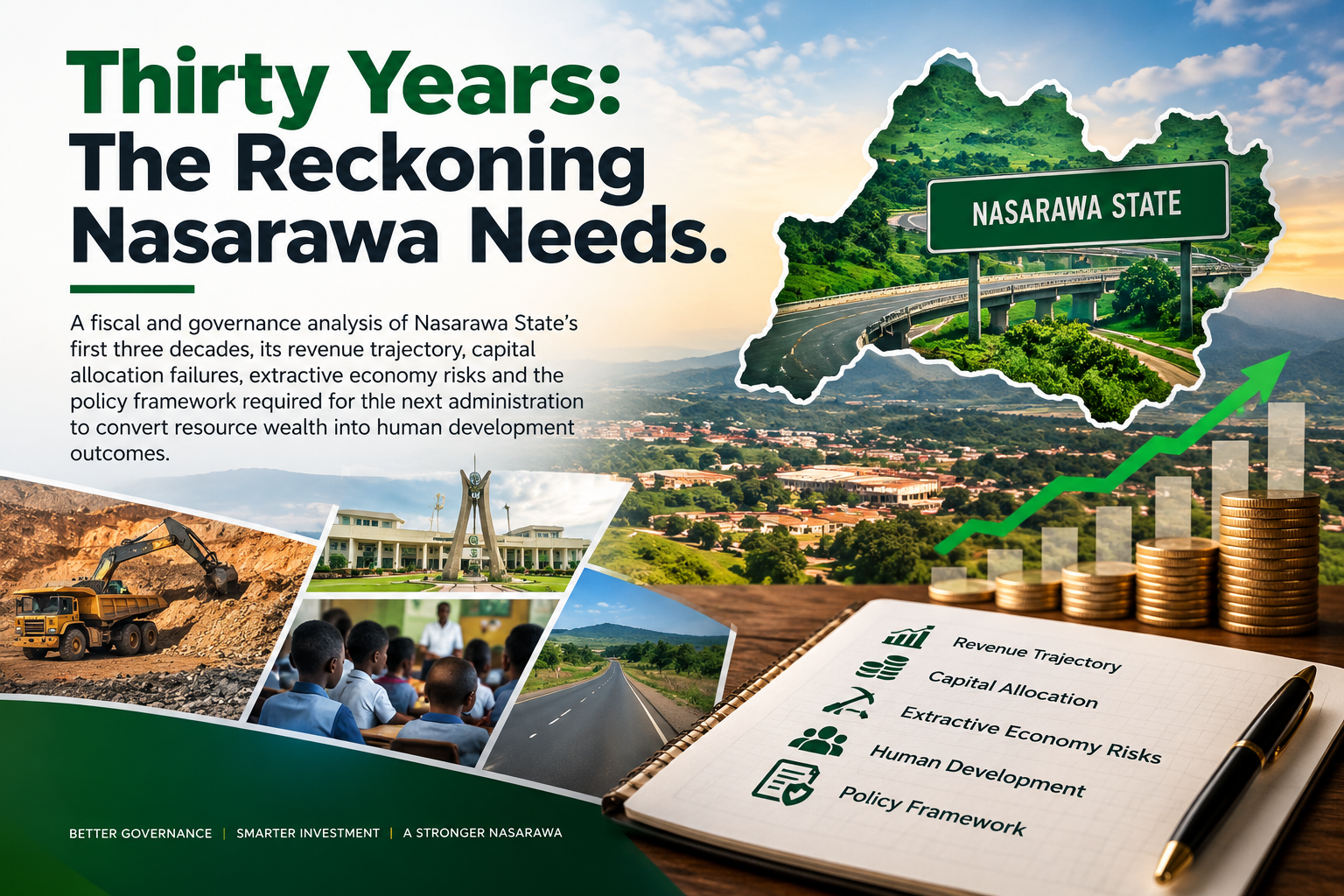
A fiscal and governance analysis of Nasarawa State’s first three decades, its revenue trajectory, capital allocation failures, extractive economy risks and the policy framework required for the next administration to convert resource wealth into human development outcomes.
By Adigidzi Oscar Kotso
Abstract
Nasarawa State marks its thirtieth year of existence against a backdrop of genuinely transformative fiscal and economic change. Internally Generated Revenue growth from ₦7.7 billion in 2019 to ₦52 billion in 2025, over $1.23 billion in recorded foreign direct investment in 2024 and the emergence of a lithium processing economy that positions the state as a critical node in the global energy transition supply chain. Yet these macro indicators mask structural governance failures, regressive public expenditure allocation, concentrated investment geography, inadequate extractive revenue distribution and a track record of prestige capital projects that have destroyed public value rather than created it. This paper analyses those failures, assesses the fiscal space available to the next administration and recommends a priority governance framework for converting Nasarawa’s resource endowment into measurable human development outcomes.
I. Thirty Years: From Transfer Dependency to Nascent Fiscal Self-Sufficiency
Nasarawa State was created by Decree No. 36 of the Federal Military Government on 1 October 1996, carved from the western portion of Plateau State by the administration of General Sani Abacha. Wing Commander Abdullahi Ibrahim, the first Military Administrator, assumed control of a state with no operational budget, one tarred road, no functional water board, no tertiary educational institution and primary school enrolments of between 200 and 300 pupils per school (Leadership Nigeria, 2026). The institutional infrastructure of government had to be constructed from scratch, drawing civil servants and technical personnel transferred from Plateau State and from the federal civil service. At the 30th anniversary colloquium in Lafia on 30 September 2026, Professor Attahiru Jega, former Chairman of the Independent National Electoral Commission and one of Nigeria’s most respected governance scholars described the current state of Nasarawa as entering ‘a phase of deepening consolidation,’ having achieved a structural transformation he characterised as moving from a rural to an industrialising economy. The transformation is real and quantifiable Nasarawa’s Internally Generated Revenue (IGR) trajectory is among the most impressive of any Nigerian state in the post-2019 period. IGR grew from ₦7.7 billion in 2019 to ₦20 billion in 2021, ₦35 billion in 2023 and ₦52 billion in 2025, representing a compound annual growth rate of approximately 21% over six years (Vanguard News, November 2025; Leadership Nigeria, August 2026). The state has publicly targeted ₦60 billion in IGR for 2026. If achieved, this would represent a near-eightfold increase in domestic revenue generation within a single decade, a performance that most Nigerian states, despite far larger economies, have not approached.
Nasarawa’s IGR grew from ₦7.7 billion in 2019 to ₦52 billion in 2025, a compound annual growth rate of approximately 21% and a near eightfold increase within a decade. Solid mineral royalties and haulage revenues are the primary driver. This is the fiscal foundation the next administration inherits.
The principal driver of this growth has been the solid minerals sector, particularly the state’s lithium economy. Nasarawa hosts the highest concentration of lithium deposits in Nigeria, distributed across multiple local government areas. In 2024, the Nasarawa State Investment and Development Agency (NASIDA) recorded $1.23 billion in total investment activity, concentrated overwhelmingly in the lithium processing sub-sector (NASIDA Investment Report, 2024). The $100 million Avatar New Energy Materials facility and the $250 million Diamond New Energy plant commissioned in July 2026, are the two most significant investments, placing Nasarawa within the upstream processing segment of the global lithium-ion battery supply chain.
The geopolitical significance of this positioning should not be underestimated. The global energy transition driven by electric vehicle adoption and grid-scale battery storage has made lithium a strategic commodity. The International Energy Agency projects that lithium demand will increase fourfold by 2040 under its Stated Policies Scenario and more than sixfold under its Net Zero Emissions scenario (IEA, 2023). A state that sits on commercially viable lithium deposits and has already attracted significant processing investment is structurally well-positioned for at least two decades of sustained investor interest provided it develops the governance framework to manage that interest in the public interest.
II. The Expenditure Paradox: Revenue Growth Without Outcome Improvement
improvements in education, water access and primary healthcare. The data suggests it is not doing so at the rate its revenue growth makes possible.
The most striking evidence of expenditure misallocation emerges from the state’s own Q3 2025 budget performance documents. In a nine-month period, the state allocated ₦707 million to the recurrent expenditure line covering refreshments and meals, a line item that generates no productive asset, no human capital accumulation and no measurable multiplier effect on the state’s economy (Nasarawa State Q3 2025 Budget Performance Documents, cited in Sahara Reporters, January 2026). In the same period, the Rural Water Supply Agency received less than half that figure in capital expenditure. The Rural Water Supply Agency’s mandate of delivering potable water to rural communities directly addresses the single most consistent finding of household welfare surveys across the state, which identify water access as the primary unmet infrastructure need.
At the 30th anniversary colloquium, Bishop Matthew Hassan Kukah whose paper on unity and diversity in Nasarawa provided the most analytically honest public assessment of the state delivered at the official events. He framed this paradox in moral terms. Nigeria, he said, has sufficient resources to meet the needs of its citizens but not enough to satisfy the greed of some of its leaders. The formulation is memorable. The fiscal analysis supports it. Nasarawa does not have a revenue problem. It has a public expenditure management problem.
The human development indicators that contextualise this expenditure performance are sobering. Approximately 25 per cent of school-age children in Nasarawa State are not enrolled in school (Business Day/Cable Index, March 2024). This figure sits significantly above the national average for states with comparable IGR performance and is inconsistent with a state that has experienced the investment volumes Nasarawa has attracted in the past five years. The gap between fiscal performance and human development outcome is the defining governance challenge facing the state at thirty.
Nasarawa’s revenue has grown at 21% per annum for six years. Approximately 25% of its school-age children are not in school. ₦707 million was spent on refreshments in nine months while the Rural Water Supply Agency was underfunded. The gap between what the state earns and what its citizens receive is not a revenue gap. It is a governance gap.
III. The Extractive Economy: Opportunity, Risk and the Niger Delta Warning
The lithium economy presents Nasarawa with both its greatest development opportunity and its most consequential governance test. The experience of Nigeria’s oil-producing states over the past five decades provides the framework within which Nasarawa’s mineral governance must be evaluated and the cautionary evidence against which its current trajectory should be measured.
The Niger Delta analogy is instructive precisely because it has played out in its entirety. Nigeria began commercial oil production in 1958. By 2024, the Niger Delta states had received billions of dollars in federation account allocations and derivation payments over more than six decades of oil production. The human development indicators in those states remain among the worst in the country. Environmental degradation has rendered large areas agriculturally unproductive. The communities above the oil the communities whose land was penetrated, whose waterways were disrupted and whose air quality was compromised by gas flaring received a fraction of the wealth their geology generated.
The structural dynamics that produced that outcome are not specific to oil. They are specific to extractive economies governed without transparent revenue frameworks, without mandatory community benefit agreements and without independent monitoring of the gap between what is extracted and what is formally reported. Lithium is not oil. But the governance failure modes are identical.
NASIDA’s own 2024 investment data reveals the early emergence of a geographic concentration problem that, if not corrected, will reproduce the Delta dynamic at state level. Of the $1.23 billion in investment activity recorded in 2024, the overwhelming majority was concentrated in Nasarawa local government. The communities of Nasarawa Eggon, Wamba, Keana, Doma, Awe, and Obi whose land in many cases hosts the mineral deposits being processed elsewhere received a fraction of that investment. The trucks carrying lithium ore from extraction sites in outlying LGAs to processing facilities in Nasarawa and environs pass through communities that have no tarred roads, no functional primary health centres and no secondary schools with full teaching complements. An extractive revenue governance framework adequate to this challenge requires at minimum four components. First, mandatory public disclosure of royalty receipts, corporate income tax payments and community development levies by company and by LGA, published quarterly with independent verification. Second, a constitutionally ring-fenced Community Mineral Development Fund, funded by a fixed percentage of gross mineral revenues, managed by host community representatives and subject to annual audit. Third, a mandatory Environmental and Social Impact Assessment renewal requirement for all active mining licences, with compliance linked to licence continuity. Fourth, a local content requirement of no less than 30 per cent for unskilled and semi-skilled employment in all licensed mineral operations. None of these mechanisms requires new legislation from the National Assembly. All of them are within the administrative and regulatory authority of the state governor.
IV. The Capital Allocation Failure: A Case Study in Public Value Destruction
No analysis of Nasarawa’s fiscal history at thirty is complete without examining the Lafia Cargo Airport, the state’s most instructive and expensive lesson in the consequences of capital allocation driven by political legacy rather than economic analysis.
The project was conceived during the administration of Governor Umaru Tanko Al-Makura and commissioned by President Muhammadu Buhari. The facility, built on a 1,000-hectare site approximately eight kilometres from Lafia near Kwandere, was designed as a cargo hub intended to serve Nasarawa’s agricultural and mineral export economy. The economic case for a dedicated cargo airport in a state located 129 kilometres from Nnamdi Azikiwe International Airport, one of the busiest aviation hubs in West Africa was never subjected to a credible demand analysis. No independent aviation feasibility study that would satisfy the minimum standards applied by the International Air Transport Association (IATA) for airport investment decisions was published (Premium Times, August 2025).
At least ₦15 billion in public funds was confirmed disbursed for the project with some estimates placing the total allocated figure at ₦18.6 billion. The facility has recorded zero commercial flights since commissioning. Investigative journalists who visited the site found an unfinished control tower, a partially collapsed cargo section, a deteriorated access road washed out by flooding, and evidence of rodent and reptile occupation of the terminal buildings (Premium Times, August 2025; This Day Live, February 2025; Leadership Nigeria, January 2025). The outgoing governor flew from the airport on his handover day in a gesture designed to demonstrate operational status. The airport was not operational. It has not become so. Of all state-government-built airports across Nigeria, none is commercially viable. The failure rate reflects a systemic pattern of prestige-driven capital allocation that prioritises the visibility of infrastructure over its economic utility. Nasarawa’s airport is one data point in that pattern. Its specificity lies in the opportunity cost it represents: ₦15 billion deployed against the state’s documented infrastructure deficit in rural water, primary healthcare, feeder roads and school rehabilitation would have generated measurable improvements in household welfare indicators within a five-year timeframe. Deployed as a non-operational airport, it has generated nothing beyond the political symbolism of its commissioning photograph.
Opportunity cost analysis, ₦15 billion at a conservative public infrastructure multiplier of 1.5, the lower bound estimate applied by the World Bank for Sub-Saharan Africa rural infrastructure would have generated ₦22.5 billion in economic value through water, health, and road infrastructure. The airport has generated zero. This is the fiscal cost of legacy-driven capital allocation.
V. The Pioneers the Record Forgot
A technically rigorous analysis of Nasarawa’s thirty years would be incomplete without acknowledging the human capital that built the state’s institutional foundations before any budget existed to fund them. The IGR figures and investment data that define the state’s current fiscal position rest on an institutional architecture that had to be constructed from nothing in 1996 by individuals whose contributions do not appear in the formal record.
My late mother, Bilhatu Azizi Kotso, was one of those individuals. She established the Nasarawa Transport Service in the state’s earliest operational years, the public bus network that provided mobility infrastructure for farmers, traders, civil servants and schoolchildren across a territory that had no functioning public transport system at the moment of its creation. She named the service with a phrase that captured precisely the institutional ambition that the state needed at that moment, ‘On the Move.’ The Lafia street adopted it as their own, calling the buses ‘Adamu’, a localised vernacular endorsement that is in the language of public policy, evidence of citizen uptake and service legitimacy.
She built that service with a dedication that appears in no official record, because she was a woman in the early years of a state that was still, in every institutional sense, deciding which contributions it would formally recognise. There were many like her. The formal history of Nasarawa at thirty will commemorate its governors and commissioners. The institutional history, the one that actually explains how the state’s administrative capacity was built belongs equally to the founding generation of civil servants, transport managers, health workers and educators who transferred from Plateau State or returned from elsewhere to build something from nothing. Their contributions are the foundation on which every subsequent achievement rests.
VI. A Governance Framework for the Next Thirty Years
The fiscal and governance analysis in the preceding sections points toward a specific, actionable policy framework for the next administration. The framework is organised around six priority domains, each of which addresses a documented failure mode from the state’s first thirty years.
6.1 Public Expenditure Rationalisation
The first priority of the incoming administration should be a comprehensive public expenditure review, completed within the first 90 days of office and published in full. The review should identify and quantify recurrent expenditure lines with zero or negative developmental multiplier, official hospitality, overseas travel, vehicle procurement and related administrative overhead , and establish statutory caps on each enforceable through the Nasarawa State Public Finance Management Law. Conservative modelling based on the Q3 2025 budget data suggests that rationalisation of these lines alone could free ₦3 billion to ₦5 billion annually for redeployment to capital expenditure without any increase in total budget size.
6.2 Rural Water Infrastructure
The state’s failure to deliver potable water to rural communities is its most visible and most politically consequential human development gap. The next administration should establish a constitutionally ring-fenced Rural Water Capital Fund, funded at a minimum of ₦3 billion annually from solid mineral revenues and governed by a dedicated agency with a statutory mandate to deliver functional water points, solar-powered, community-maintained boreholes to every community of more than 200 persons within four years. The fund should be protected against executive reallocation by a supermajority requirement in the State House of Assembly
6.3 Extractive Revenue Transparency
The state should introduce a Nasarawa Extractive Industries Transparency Initiative (NEITI), a state-level equivalent of the national EITI framework requiring quarterly public disclosure of all royalties, taxes, levies and community development contributions paid by mineral licence holders, disaggregated by company and by LGA. The framework should include an independent reconciliation process, carried out by a firm with no commercial relationship with any licence holder and a public grievance mechanism for host communities. Compliance should be a condition of licence renewal.
6.4 Capital Expenditure Discipline
The airport experience demands a structural reform of the state’s capital project approval process. The next administration should introduce a mandatory independent feasibility assessment conducted by a qualified consultancy with no conflict of interest in the project outcome for any proposed capital expenditure above ₦1 billion. The assessment should include demand analysis, cost-benefit analysis using a minimum 10% discount rate, opportunity cost analysis against alternative deployments of the same capital and a post-completion revenue projection. No project above the threshold should proceed to budget without a published assessment. The Lafia Airport proceeded without one. The result is on the public record.
6.5 Asset Performance Audit
Before any new infrastructure is commissioned, the next administration should mandate a comprehensive audit of every existing state asset, primary health centre, technology hub, agricultural mechanisation centre, market and school rehabilitation project assessing operational status, cost-to-full-operationalisation and community utilisation rate. Each asset should receive one of three classifications: operationalise within six months, repurpose for documented community need or decommission with staff redeployment. Capital expenditure should follow the audit, not precede it. This principle of audit before construction is the single most cost-effective governance reform available to an incoming administration working within an existing budget.
6.6 Karu-Mararaba-Gurku Strategic Corridor
Nasarawa’s most underexploited fiscal asset is its border with the Federal Capital Territory. The Karu-Mararaba-Gurku axis represents the primary economic interface between the FCT and Nasarawa, carrying daily commuter and commercial traffic that has generated substantial informal economic activity but minimal formal tax revenue for the state. A targeted infrastructure investment programme, road upgrading, formal transport hubs, land titling and commercial zone development along this corridor would generate real estate appreciation and land administration revenue at a rate that would more than offset the investment within a five-year horizon. The corridor should be designated a Strategic Economic Zone with dedicated infrastructure allocation and a simplified land titling process, making it the first priority within the state’s next capital expenditure programme.
VII. Conclusion: The Promise of On the Move
Nasarawa State at thirty is a fiscal success story with a governance deficit. It has built the revenue engine that its founders could not have imagined in 1996. It has attracted investment that positions it within the global energy transition supply chain. It has maintained political coherence across a territory of extraordinary ethnic diversity. These are real achievements and they belong to every generation of Nasarawa citizen and civil servant who contributed to building them. They are not, however, sufficient. A state that earns ₦52 billion annually in domestic revenue and still leaves one in four of its children out of school has not yet answered the foundational question of what public revenue is for. A state that spends more on refreshments than on rural water infrastructure has not yet built the expenditure culture that its revenue growth demands. A state that buried ₦15 billion in a field near Lafia has not yet demonstrated that it can distinguish between what is good for political legacy and what is good for public value.
The next administration inherits the best fiscal position in the state’s history. It also inherits the accumulated governance deficits of thirty years. The framework recommended in this paper, expenditure rationalisation, ring-fenced rural water investment, extractive revenue transparency, capital expenditure discipline, asset performance audit and strategic corridor development does not require a larger budget. It requires a different deployment of the budget that already exists.
Thirty years ago, my mother put ‘On the Move’ on the side of a bus and meant it as a promise. The promise has been partly kept. The next thirty years will determine whether Nasarawa moves toward the destination that revenue growth makes possible or whether it continues to generate wealth at the macro level while delivering inadequate outcomes at the household level.
The answer depends on a single variable, whether the next governor can build a governance framework that converts naira collected into outcomes delivered. That framework is available. The fiscal space to fund it exists. The political will to deploy it is the only missing input.
References
Business Day/Cable Index (March 2024) Out-of-school children data, Nasarawa State.
IEA (2023) Critical Minerals Market Review. Paris: International Energy Agency.
Leadership Nigeria (August 2026) Nasarawa IGR performance data.
Leadership Nigeria (January 2025) Lafia Cargo Airport update.
NASIDA (2024) Nasarawa State Investment and Development Agency Annual Investment Report.
Nasarawa State Government (2025) Q3 2025 Budget Performance Documents.
New Telegraph / Vanguard News (30 September 2026) Reports on Jega and Kukah 30th anniversary lectures.
Premium Times (August 2025) Investigative report: Lafia Cargo Airport.
Sahara Reporters (January 2026) Nasarawa State budget expenditure analysis.
THISDAY / Vanguard (2025) Nigerian state airport commercial viability analysis.
This Day Live (February 2025) Lafia Cargo Airport: update on operational status.
Vanguard News (November 2025) Nasarawa State IGR and mineral revenue data.
Adigidzi Oscar Kotso is a child of Nasarawa State, who writes on the history and identity of Nigeria’s Middle Belt minority peoples. The views expressed are his own.
Leave a Reply