The Killing in Eggonland: Wulko, 1912 and What Britain Did Next.
Adigidzi Oscar Kotso
A child of Eggon heritage | Part Three of the Being Eggon Series
I am Eggon. That is not a disclaimer. It is an orientation and it is the same orientation I have written from in everything that precedes this.
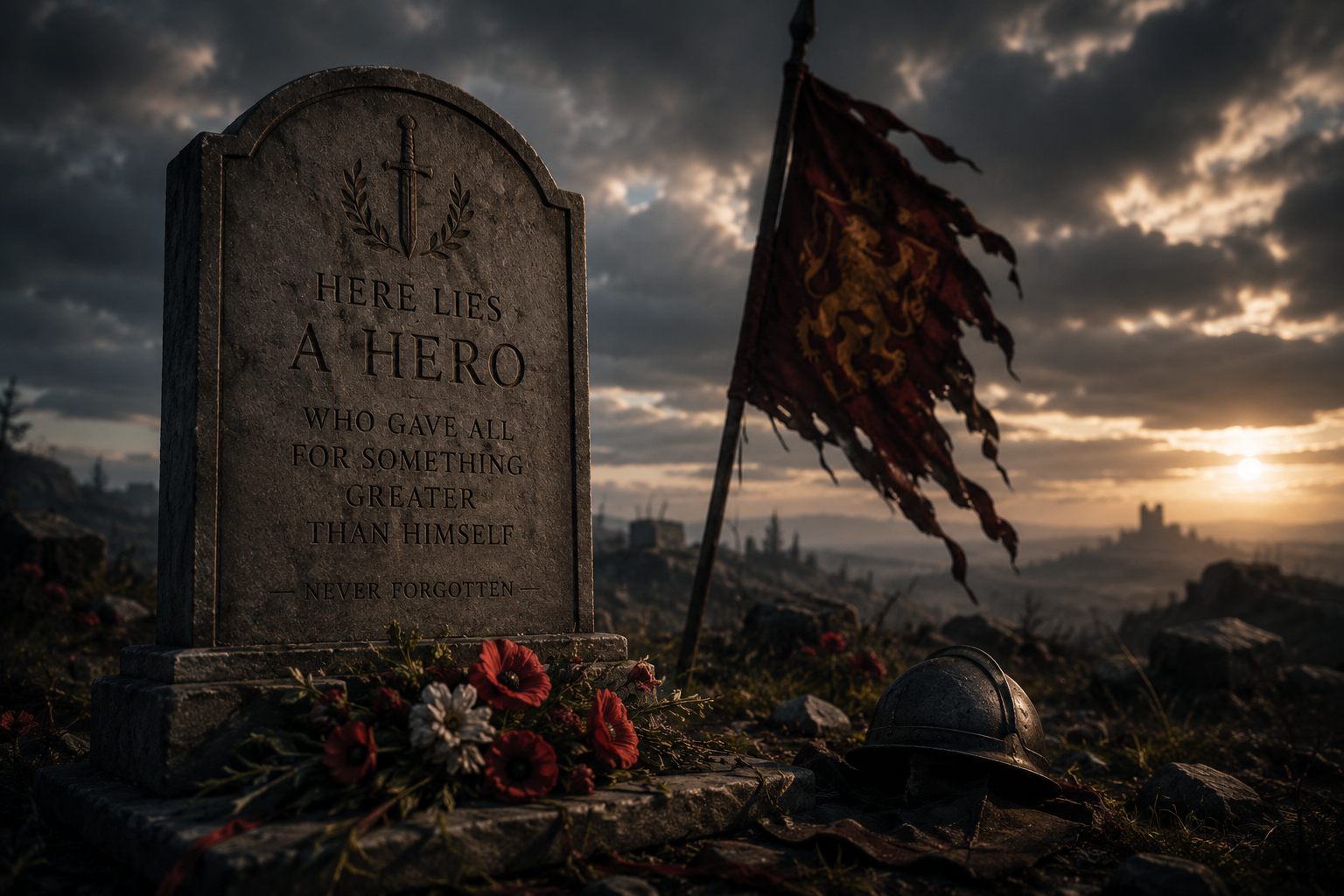
I write this knowing that Campbell’s grave still stands at ancestral Wulko Village, in the Eggon Hills above what is today Nasarawa Eggon Local Government Area of Nasarawa State, a heap of stones at Kilometre 14 on the Akwanga–Lafia Highway. To reach it, you turn off at Wowyen, the neighbouring village at Kilometre 16 on the same highway, and travel approximately four kilometres inside. It is an unmarked pile of stones in the ancestral ground of my people, declaring by its very presence that a European died here and that the killing was answered. There is no monument for the women and children who died in the cave on a mountain cliff overlooking ancestral Wulko Village. There is no marker there. There is no grave for Mashi Ekuembi, the only survivor, who walked out of that cave with a baby on her back and then died of what she had seen. There is no memorial for the 179 Eggon people whose deaths a Colonial Office official confirmed in writing at Kew, in passing, in a letter clarifying a headcount.
In the two essays that precede this one, I argued that the Eggon held their hills against the Caliphate for the better part of a century, that Keffi pressed from the west and Nasarawa from the south and neither broke through. I argued that we were not a slave pool preserved by imperial design. We were unconquered. That argument was about the nineteenth century. This essay is about what happened next when the British arrived with Maxim guns and what those guns were used for.
What there is, is memory. Oral history, preserved across four generations, still naming names at Wulko in 2003 when a researcher sat with M. Namo and others and wrote down what they said. And there is the archive, fragmentary, euphemistic, bureaucratic, but legible between its own lines to anyone who knows how to read what colonial correspondence refuses to say directly.
I am going to say it directly.
A note for readers encountering this history for the first time: In May 1912, a British mining engineer named Campbell entered the Eggon Hills of what is today Nasarawa State, Central Nigeria, to survey land for tin prospecting. He had entered territory the colonial administration had formally acknowledged was not under British control. He placed survey beacons near Eggon farms, uprooted crops, and ignored formal warnings from the elders of Wulko village. He was killed by an Eggon man named Alaku Awazi. The British colonial government responded with a military punitive patrol, led by Captain Hopkinson, which destroyed Wulko and neighbouring villages, seized the community’s stored food, and killed 179 Eggon people, a figure confirmed in writing by the Colonial Office in London. A group of women and children who had taken shelter in a cave on a mountain cliff overlooking ancestral Wulko Village were killed when the soldiers threw explosives into the cave. Only one woman, Mashi Ekuembi and her baby survived. They both died shortly afterwards. This essay tells that story from the Eggon side, using colonial archives, peer-reviewed scholarship and oral history preserved across four generations at Wulko.
I. Our Hills Were Not Empty.
The Eggon Hills were not a frontier when Campbell arrived. That word, frontier, is one of the empire’s most persistent lies. It implies an edge, a limit, a space not yet organised. Our hills were organised. Deeply, intricately, spiritually organised, by a system of governance that the British had neither the patience nor the vocabulary
to understand and so classified as primitive and moved past.
My people, Wulko Village of Eggon Eholo, governed themselves through the Ashim, which was simultaneously a religion, a legal code, a political institution, and a covenant with the earth. The Mo’andakpo Ashim, the council of elders held executive, legislative and judicial authority. The Adan Ashim presided as high priest. The Adan Ubin, the father of the land held final authority over the covenant between the people and Ubin, the earth deity, one of the specific sacred presences within the cosmological framework already described in this series created by the supreme Ahogben. Every village, including Wulko, maintained its own Anva Ashim, a sacred grove that was the ritual heart of that covenant (Dorward, 1984, p.85; Alumbugu et al., 2025).
This is not folklore. This is governance. Decisions about war and peace, about land use, about punishment, about marriage all of it flowed through institutions with defined roles, succession rules and legitimacy grounded in the spiritual authority of the ancestors (Dorward, 1984, p. 85). When the Mo’andakpo of Wulko sent a warning to Campbell, they were not asking him nicely. They were issuing a lawful notice from a functioning sovereign institution. They had the authority to do so. They exercised it. He ignored them. We were in the hills, not because the hills were all we deserved, but because the lowlands had been taken. The nineteenth-century jihad of Usman Dan Fodio drove Fulani emirate power across what is now Nasarawa State, and the peoples of the middle ground, my people among them, retreated to the granite heights where cavalry could not follow. As I have documented in the preceding essays, the Keffi Emirate pressed from the west and the Nasarawa Emirate from the south. Both flanked us. Neither broke through. The hills were not poverty, they were strategy and they were sovereignty. And in those hills, we farmed.
Farming was not incidental to Eggon life in 1912. It was the covenant itself. To destroy a crop was to desecrate the relationship between the living and the earth that sustained them.
Locust beans, which provided protein and seasoning across the dry months. These were not abstract commodities. They were the physical expression of the covenant between the people and Ubin. And 1911 had already been a hard year. Harvests had failed. The 1912 planting season was arriving with uncertain rains. The farms that Campbell’s survey beacons threatened were not fields of surplus. They were the margin between life and famine. We know this, because a year later, the Resident of Nasarawa was writing letters about the famine at Wulko (NAK 10/339p, 1913; Ayuba, 2007, p. 78). The archive confirms what our oral history preserved.
II. The Man Who Came for Our Tin.
Campbell did not arrive by accident, he arrived because of tin and because the colonial economy of northern Nigeria in 1912 was built on the assumption that indigenous sovereignty was an inconvenience to be managed, not a legal reality to be respected.
By 1912, the northern Nigerian tin rush was at full speed. Seventy European tin companies were operating and this led to fresh prospectors flooding into Nasarawa Province. The colonial government knew the Eggon hills were not pacified. It had formally ordered that the Akwanga area was ‘not fully brought under British control’ and prohibited mining exploration on those grounds. Prospectors moved ahead anyway (Ayuba, 2007, p. 43). The order existed on paper. The tin existed in the ground. The choice was not difficult for men of Campbell’s type.
Campbell was not a naïve adventurer stumbling into unfamiliar territory. The primary colonial record, Minute Paper No. 2726/1912, the original correspondence file on his death identifies him throughout as ‘Mr. D.A. Campbell,’ a mining prospector employed by the Benue Company. He and his colleague James Poole had been based at Gako, the Benue Company’s mining camp to the south-west of Arikya in the Lafia Division for two weeks before the killing (Resident Nassarawa Province, Confidential Report No. 410/12, 8 June 1912). He was a veteran mining engineer with a documented track record. At Riruwai, Kano, a historically significant centre of pre-colonial Hausa tin smelting and mining, where indigenous miners had worked ore deposits for generations, Campbell had already become notorious for high-handed behaviour (Ayuba, 2007, p. 44; NAK SNP 20/79p/1913).
The colonial administration knew. They licensed him anyway. The Exclusive Prospecting Licences that men like Campbell carried had no territorial size limit. They were instruments of dispossession with almost no legal constraints on how they were exercised. Across Berom land on the Jos Plateau, crops were being destroyed without compensation for decades. The colonial government had ordered compensation at £2 per acre but enforcement was negligible (Ayuba, 2007, p. 45; Dorward, 1987, p. 205). The logic was already established that indigenous farming rights were subordinate to prospecting rights.
Campbell brought that logic into the Eggon Hills and acted on it. He placed his white-flagged survey beacons near our farms, uprooted crops, received a formal warning from the village elders but ignored it and continued as he had ignored warnings before.
I want to pause on that sequence, because it is the whole story of colonialism in miniature, the prior sovereignty, the lawful warning, the contemptuous disregard, the violence and then the punishment of the people who responded to violation with their own violence. That is the sequence. It is not complicated. It has simply been told, for over a century, from the wrong end.
III. What the White Flags Meant.
Here is something that almost no account of the Campbell killing has centred, though it was recorded both by the scholar D.C. Dorward and in Poole’s own statement preserved in Minute Paper No. 2726/1912 (NAK SNP 20/79p/1913; Dorward, 1984, p. 88): the white-flagged survey beacons were not merely metal stakes to the people of Wulko. Poole’s statement, in his own words, records that the people regarded them as ‘signs of bad Juju against coming crops’ (MP 2726/1912, Poole statement, 21 May 1912). The Anva Ashim, the sacred grove at the heart of each Eggon village’s covenant with the land contained megalith altars. Objects planted upright in the earth near farms, carrying markers, claiming authority over the land. And the Eggon cosmological framework understood precisely that foreign objects placed in the earth without ritual sanction could disrupt the covenant between the community and Ubin.
The white flags, in particular, were read as a threat to rain. This is not a primitive misreading. It is a coherent interpretation, within a cosmology where rain was not merely weather but the earth’s response to the community’s faithfulness to its covenant with Ubin (Dorward, 1984, p. 89). Something planted in the sacred earth by strangers who acknowledged no authority but their own prospecting licence was therefore a spiritual violation as much as an agricultural one. The elders knew what they were doing when they warned Campbell. They were not appealing to his goodwill. They were asserting the sovereign authority of the Adan Ubin and the Mo’andakpo over the land. They were telling him, in the language of their lawful institution, that he was in violation of the covenant that governed this territory. He had been warned at Riruwai, Kano. He was warned at Wulko. He dismissed both.
Alaku Awazi fired the first arrow because his locust beans trees were being destroyed in a year of scarcity, by a man who had already shown contempt for every human institution my people possessed.
I know his name, Alaku Awazi. I know the name of the man said to have cut Campbell’s body after he fell, Kuggah Motso. These names were still being spoken at Wulko in 2003, when J.M. Ayuba sat with community elders and recorded what they knew (Ayuba, 2007, p. 72; M. Namo et al., 2003). Almost certainly, Alaku Awazi and Kuggah Motso are the only named Wulko individuals from that generation that scholarship has managed to preserve. The colonial archive did not find them worthy of naming. Our memory did. They did not see themselves as criminals. Dorward notes, with precision, that the Eggon of this period ‘admitted the act but did not see it as wrong’ because within Eggon law and cosmology, the killing was proportionate. A man had violated the land, ignored lawful authority, destroyed food in a time of need and made himself an enemy of the covenant. The response was grounded, not in rage, but in law.
IV. Two Armies. Two Worlds.
I want to be honest about what my people walked into when the British patrol arrived.
Eggon warfare was ritually regulated. Not primitive but regulated. The Ashim institution governed the conduct of conflict as rigorously as it governed everything else. The Adan Ubin and the Adan Ashim of the warring clans supervised engagements and held power to halt them. Warriors used bows, poisoned arrows, shields, swords and daggers. They fought in dispersed order and moved to close combat. And crucially, the death or wounding of a few was generally sufficient for both sides to withdraw. Eggon warfare was calibrated and it existed to establish precedence, enforce a boundary, settle a dispute and not to annihilate. The regulation of war was also a regulation of death (Dorward, 1984, p. 91; Alumbugu et al., 2025).
The British patrol had no such regulation. It carried rifles and it carried explosives. It carried an instruction from the Resident of Nasarawa, Captain Lawrence, that gave the soldiers what amounted to a licence to kill without limit (NAK SNP7/2812, 1912; Ayuba, 2007, p. 56):
The entire district must learn once and for all that the white man shall be regarded as sacred. To tie a European up and murder him cannot be permitted to pass without the severest punishment.
The word sacred sits in that sentence like a theological claim. Lawrence was asserting the inviolability of European persons in colonised space, a kind of secular divinity. He was not wrong that this was the colonial theology. But he was speaking into a world where sacredness was already assigned to the land, to the earth covenant, to the Anva Ashim, to the Mo’andakpo who had issued the lawful warning that Campbell ignored. Lawrence’s instruction did not merely authorise a military operation. It declared that British sacred order superseded Eggon sacred order. And it backed that declaration with firepower. The people of Wulko had built their defences with everything they had. Captain Hopkinson, the patrol commander, described what he found in his official report:
The enemy placed great reliance on their fortifications which were constructed with considerable skill. Stone walls topped with thorn bushes recessed to stop enfilade fire and with cunningly concealed entrances, also thick thorn hedges with stone walls behind them were used by the enemy.
Those walls were not improvised. They were the product of centuries of Eggon military thinking, refined through inter-clan warfare and through decades of resisting Fulani cavalry raids. The people of Wulko had built their hilltop settlements precisely because height gave defensive advantage. These were not primitive barricades. They were the best available expression of a sophisticated military tradition meeting a qualitatively different threat. They were not enough. They could not have been enough. That is not a military judgement. It is a political one.
V. What They Did to Wulko.
The primary record establishes the precise chronology. Campbell was killed on 13th May 1912 (Resident Nassarawa to C.S. Zungeru, Telegram 341, 22.5.12: ‘He was killed on 13th or 14th inst’). His body was found five days later on 18th May by Assistant Resident Mr. Mair, ‘a headless and limbless body’ in the words of Dr. Courtney’s report, cited by the Resident (MP 2726/1912, Sheet 11). It was buried at Wulko that same day. A burial service was conducted by Captain Hopkinson of the West African Frontier Force and Mr. Mair. The Resident’s confidential report states explicitly: ‘A proper grave was dug, over which a cairn of stones has been built’ (Resident Nassarawa Province, Confidential Report No. 410/12, 8 June 1912). That cairn remains at ancestral Wulko Village to this day. The patrol arrived at Gako, the colonial mining camp approximately twelve kilometres from ancestral Wulko Village on 22nd May 1912. The soldiers moved on ancestral Wulko Village the following day, 23rd May. The villages implicated in Campbell’s killing were destroyed. The soldiers had licence, expressed explicitly in Lawrence’s instruction to kill, loot and eliminate the infrastructure of Wulko life. They exercised it in full (NAK SNP7/2812, 1912; PRO CO 446/106, 1912). Six hundred bundles of guinea corn were seized and taken to Wamba, where they were rationed to British soldiers and camp followers (NAK SNP7/281, 1912). Six hundred bundles of our food, taken from farms that Campbell had himself been destroying, carried away to feed the men who had just burnt our houses. The Resident of Nasarawa, in a sentence that reads like an anomaly in the colonial archive, later wrote: “so much hardship to innocent people has I believe, been caused by this prompt intervention by troops, that I would personally vote against it every time.” He voted against it in a letter. He said nothing publicly. The operation continued. The grain was eaten.
The official casualty count is confirmed in the parliamentary record preserved in Minute Paper No. 2726/1912. On 3rd February 1913, Mr. John Lyttelton asked the Secretary of State for the Colonies in Parliament for particulars of casualties, specifically whether any women or children were among the dead and wounded.
Harcourt replied that ‘these estimates range from 179 total casualties to 130 killed’ and that ‘so far as I am aware, no women or children were killed or wounded. Of the troops engaged, one officer and 10 men were wounded’ (MP 2726/1912, Sheet 8, Parliamentary Q&A, 3 February 1913; PRO CO 446/105, 1912; Ayuba, 2007, p. 61). The cave massacre had already occurred. The 179 figure did not include those killed in it.
The colonial correspondence was, as Ayuba notes, silent about the massacre of women and children during the patrol (Ayuba, 2007, p. 63). That silence was deliberate. Here is what community memory preserved through four generations and still being spoken at Wulko in 2003 tells us:
A group of women and children who hid in a cave on a mountain cliff overlooking ancestral Wulko Village were killed when explosives were thrown into its mouth. There is no marker there.
This is from the testimony of M. Namo and others, collected by Ayuba in November 2003 (M. Namo et al., 2003, cited in Ayuba, 2007, p. 63). Dorward, who conducted oral history interviews in 1974 and again in 1982, recorded the account in more
detail (Dorward, 1984, p. 93):
The soldiers started setting houses ablaze and shooting all over. They started shooting until they came to a neighbouring village called Endehu, who were not involved. Soldiers pursued the Eggon even across to Wowyen… They hid in the cave for some time. No one knows how, but the soldiers found them and started shooting inside and killed all but one woman, named Mashi Ekuembi. She was the only survivor from that place, she with her baby on her back. But because of seeing so much death, even this woman and her baby died of illness.
Mashi Ekuembi. I write her name in full, because names are how we refuse forgetting. She walked out of that cave. She was carrying her baby. She had just watched everyone else die, every woman, every child, every person who had fled there seeking the protection that stone and darkness could offer against rifles. She walked out. And then she died. And her baby died. Of illness, the account says. Of what we now understand as the collapse that follows extremity of horror, of witnessing, of survival that the body cannot contain.
The cave has never been formally located. Dorward searched for it. The Eggon Hills are Young Granites, he notes, broken by deep fissures, undercut by erosion into overhanging clefts. He never found it (Dorward, 1984, p. 94). But its physical reality, he rightly argues, is immaterial to its cultural reality. The cave is real. It is real in the way that all decisive historical spaces are real, as the geography of an event that cannot be undone, that must be named, that refuses to be buried under a century of administrative silence.
Endehu, a neighbouring village that had no involvement in Campbell’s killing was also attacked. The patrol moved through uninvolved communities. Wowyen was targeted. The violence extended far beyond any principle of proportionality or targeted response. This is what British punitive expeditions did across Nigeria in this period, collective punishment, deliberate food destruction, generalised terror. Wulko was not an exception. It was the pattern.
VI. The Scandal That Changed Nothing
The Wulko campaign became public. Reuters’ agent in Nigeria filed a report. It made the British press. Questions were asked in Parliament. The Secretary of State for the Colonies, Lewis Harcourt, came under pressure from Mr. Travers Buxton of the Anti-Slavery and Aborigines’ Protection Society, the humanitarian lobby group formed in 1909 from the merger of two predecessor organisations with a combined history stretching back to 1837 (Ayuba, 2007, p. 65; PRO CO 446/105, 1912).
Buxton wrote to the Colonial Office. He was alarmed by newspaper accounts stating that villages had been destroyed and a large number of natives killed. He wanted particulars. He described the punishment as ‘apparently indiscriminate.’ He was not wrong.
The Colonial Office responded with the bureaucratic precision of an institution that has learned to acknowledge without admitting. Mr. Lewis, a senior official, clarified the casualty figure. ‘you put the number at 125. This was the number in the main engagement, but the total number throughout the operation was 179.’ One hundred and seventy-nine. Confirmed. In writing. In the files at Kew (PRO CO 446/105, 1912). No woman or child counted in that tally. No account of the cave. No mention of Endehu. No reparation. No censure of Lawrence or Hopkinson. No refund of the 600 bundles of grain.
The Anti-Slavery and Aborigines’ Protection Society could ask questions. It could not change the calculus of empire, that the safe passage of mining prospectors and the revenue they generated were worth the blood of 179 Eggon people.
What the scandal did produce was a policy change, not from conscience, but from calculation. The publicity from Wulko forced the colonial administration in Akwanga to adopt what officials called a ‘softly softly’ approach, avoiding extreme measures against local communities. The unintended consequence of that approach was that tax collection in the Eggon hills became effectively impossible, because the British could no longer credibly threaten force. A nominal tribute for 1913 was imposed and never collected. A follow-up patrol sanctioned in May 1914 was immediately withdrawn when the First World War began (Ayuba, 2007, p. 68; Ayuba, 2008, p. 44). My people had, in a perverse sense, forced a pause. It cost them 179 lives, a cave massacre, and a famine to do it.
VII. The Famine Nobody Compensated.
The patrol ended, the soldiers went back to Wamba and the British press moved to the next story.
What remained at Wulko was a community that had lost its food.
The six hundred bundles of guinea corn seized in May 1912 were the stored harvest of a community that had already suffered poor harvests in 1911. The 1912 growing season already compromised before the patrol arrived and had been further devastated by the burning of houses, the destruction of farms and the displacement of the population into the hills and surrounding areas. The rains that followed were not sufficient. By 1913, the Resident of Nasarawa was writing to the Secretary of the Northern Provinces about a localised famine at Wulko. The file is at Kaduna: NAK 10/339p, Resident Nasarawa to Secretary, Northern Province, Mada District Famine, 11 July 1913.
A famine caused by colonial military action, documented in colonial archives, with no mechanism for redress and no record of compensation. The connection between Campbell’s survey beacons planted to protect the interests of British mining capital and the starvation of Wulko’s surviving population one year later is direct, causal and traceable through the archival record. I am tracing it. Here, in writing, as a child of Eggon heritage, in 2026.
VIII. The Myth That Carried the Truth.
Wulko did not remain merely a local event. It became, in Dorward’s precise formulation, a prototype myth encompassing the colonial experience of all Eggon, not just those directly involved in the Wulko hills campaign (Dorward, 1984, p. 96).
By 1982, when Dorward was conducting his oral history interviews across the Eggon hills, the memory of the campaign had expanded to encompass the entire subsequent conquest of the region between 1912 and 1917 collapsing multiple punitive patrols into a single narrative arc (Dorward, 1984, p. 97). From Wulko the soldiers went to Wowyen. In the Wowyen account, a hyena lay outside the cave where the Wowyen people were hiding and when the soldiers saw it, they did not enter but they passed on. That is why, to this day, the people of Wowyen do not kill hyenas. From Wowyen the patrol went to Egibi. Then to Ogye. The myth extended the Wulko campaign into the conquest of all Eggon, because that is what the Wulko campaign was, the beginning of the end of our sovereignty on those hills.
This mythologisation is not distortion but political memory doing what political memory is supposed to do, finding the event that names the wound. We named it Wulko. We named Alaku Awazi. We named Kuggah Motso. We named Mashi Ekuembi. We kept the names when the archive refused to write them down.
There is something else I need to say. The Wulko campaign unfolded in 1912, at the very moment when Frederick Lugard was preparing to amalgamate Northern and Southern Nigeria under his system of Indirect Rule. Lugard was returning to Nigeria after five years away. The moral scaffolding of Indirect Rule depended on the fiction that British administration was protecting African institutions rather than destroying them, governing through native authorities, respecting tradition, ordering the transition to modernity with a gentle hand. The Wulko scandal where 179 people were killed, a cave bombed, villages burnt, grain seized, a famine produced, all because a licensed prospector ignored a lawful warning from indigenous elders was exactly the kind of event that exposed that fiction for what it was. The administration buried it in correspondence and moved on. We did not move on.
IX. What the Record Establishes.
I want to state plainly, from the evidence, what happened:
Campbell’s killing was lawful by Eggon standards. The elders issued a formal warning. He violated the land. He destroyed food in a time of scarcity. He disregarded the sovereign authority of the Mo’andakpo. What Alaku Awazi did was not crime. It was enforcement.
The British patrol was disproportionate by any standard including
their own. The Resident of Nasarawa said so in writing. The destruction of uninvolved Endehu, the attack on Wowyen, the cave massacre, the seizure of food, none of these were proportionate responses to one man’s death. They were
collective punishment.
The famine was caused by the patrol. Not by drought alone. Not by poor farming. By the seizure of 600 bundles of grain and the destruction of the agricultural infrastructure of a community that had already suffered a bad harvest. The causal chain is in the archive.
The cave massacre was a war crime. In contemporary humanitarian law terms, the deliberate killing of non-combatant women and children sheltering in a cave, by explosives, is a war crime. It was not reported. It was not acknowledged. It was preserved only in the oral history of the people it happened to.
Our memory is the most reliable record. The colonial archive is silent about the cave. Our oral history is specific about women, children, a cave, explosives, Mashi Ekuembi, a baby, death. That specificity, preserved across ninety years of oral transmission and still accurate enough to record in 2003, is not rumour. It is testimony. The colonial administration knew what it had done. In internal Colonial Office correspondence dated 6th September 1912, not for public consumption, not for Parliament, but between officials, a senior figure wrote: ‘It is possible that Mr. Campbell, had he been discreet, might have avoided the trouble in the first place’ (MP 2726/1912, C.S. minute, 6.9.12). They wrote that in private. They said nothing of the kind to Parliament.
X. The Grave and the Name.
Campbell’s grave, a cairn of stones is still at ancestral Wulko Village. It was built to be permanent.
I have thought about that grave. I understand why it was built, not just as a marker for the dead, but as a statement about who mattered, whose death required a monument, whose loss warranted a punitive expedition and a policy change and a press scandal and questions in Parliament. Campbell died and 179 Eggon people plus however many died in a cave were the consequence. One grave. No consequence for the other deaths. No inquiry. No reparation. No monument for Mashi Ekuembi, who survived everything and then did not survive it.
They left a grave. We kept the names.
That is the Eggon answer to what happened at Wulko. Not a monument, monuments can be built by people with stone and mortar and the authority to declare what matters. We did not have that authority in 1912 and for a long time we did not have it in writing either. What we had was the transmission of names, Alaku Awazi, who fired the first arrow and did not see it as wrong. Kuggah Motso, who was there when Campbell fell. Mashi Ekuembi, who carried her baby out of the cave and carried the horror until it killed her.
I carry those names now. I set them down here, in full, in a document that will be archived and read and cited, as an act of scholarship and as an act of conscience. These are not data points in a colonial history of Northern Nigeria. They are my ancestors’ names.
The cave is on a mountain cliff overlooking ancestral Wulko Village, in the Eggon Hills. The fissures and overhanging clefts of Young Granite, broken by erosion, wind and the passage of a century and more. Dorward looked for it and did not find it. But its reality does not depend on its location. It is real because what happened there was real, and because the people who remember it have not stopped remembering.
I am Eggon. I speak Hausa because of the weight of history, trade, colonialism, urbanisation and missionary priorities. I carry the names Alaku Awazi, Kuggah Motso and Mashi Ekuembi because the archive refused to write them. This is what we know. This is what happened. This is the record I am adding my name to.
Adigidzi Oscar Kotso
Adigidzi Oscar Kotso is a child of Eggon heritage on a mission to document, preserve and champion the identity and history of Nigeria’s Middle Belt minority peoples before the story disappears.
Acknowledgement
The author wishes to acknowledge his father, Elder John Ebgaku Kotso, the Aren Engla of Wulko, born in ancestral Wulko Village, where he lived his early life. His oral testimony provided essential corrections and additions to this essay. The title Aren Engla is conferred within the Eggon community upon one recognised as deeply learned and it is not inherited but earned. His testimony represents living memory transmitted with precision across a lifetime rooted in the community this essay describes. No archive holds what he knows. Elder Kotso also provided the author with a copy of Minute Paper No. 2726/1912, the original 138-page colonial correspondence file on the death of Mr. D.A. Campbell, including the Resident Nassarawa Province’s Confidential Report No. 410/12 and a Northern Nigeria Survey Office map of Awulco, Lendum and Wieme dated 19 August 1912. This primary document, sourced from Edinburgh, has not previously been cited in published scholarship on the Wulko events of 1912.
Sources
Archival
NAK SNP7/2812: Mada Patrol, 1912 — orders and conduct. [Note: The full primary correspondence file on the death of Mr. D.A. Campbell is Minute Paper No. 2726/1912 (138 pages), comprising telegrams, field reports, parliamentary records, and the Resident Nassarawa Province’s Confidential Report No. 410/12, together with a Northern Nigeria Survey Office map of Awulco, Lendum and Wieme dated 19 August 1912. A copy was provided to the author by Elder John Ebgaku Kotso, Aren Engla of Wulko.]
NAK SNP7/50: Nasarawa Province, Bohon Kurmi Patrol, 1912.
NAK SNP7/281: Mada Patrol, 1912 — grain seizure.
NAK SNP 2726/1912: Lt. Governor Charles Temple to the Colonial Office.
NAK SNP 20/79p/1913: James Goldsworthy Poole, Statement, 21 May 1912.
NAK 10/339p: Resident Nasarawa to Secretary, Northern Provinces, Mada District Famine, 11 July 1913.
NAK SNP 13 O/PC 42/1925: Rex vs Anzako of Wulko.
NAK Jos Prof 44/1932: Southern Division Report, 1931–32.
PRO CO 446/105: Temple to Colonial Office, Murder of Mr. Campbell, July 1912.
PRO CO 446/106: Temple to Colonial Office, Mada Hills Punitive Patrol, September 1912.
Secondary Sources
Alumbugu, E. et al. (2025). ‘Diplomacy and War in Pre-Colonial Eggon Land of Central Nigeria, c.
1640–1945.’ In Ancient and Modern. OEN Manifold, University of Minnesota Press.
Ayuba, J.M. (2007). Social and Economic Change in Colonial North-Central Nigeria: The History of
Akwanga Division, 1911–1960. PhD thesis, SOAS University of London. DOI:
10.25501/SOAS.00028820.
Ayuba, J.M. (2008). Economy and Society in Colonial North-Central Nigeria. Zaria: Ahmadu Bello
University Press.
Dorward, D.C. (1984). ‘Ritual Warfare and the Colonial Conquest of the Eggon.’ History in Africa, 11,
pp. 83–98. DOI: 10.2307/3171629.
Dorward, D.C. (1987). ‘The Impact of Colonialism on a Nigerian Hill-Farming Society: A Case Study
of Innovation Among the Eggon.’ The International Journal of African Historical Studies, 20(2),
pp. 201–222.
M. Namo et al., group interview at Wulko, 29 November 2003. Cited in Ayuba (2007). Elder John
Ebgaku Kotso (Aren Engla of Wulko), oral testimony, April 2026. Corrections to geography of
Campbell’s grave, the two-day sequence of the patrol (Gako, 22 May; Wulko, 23 May), location
of the cave on the mountain cliff, and ethnographic designation of Wulko Village of Eggon Eholo.

Leave a Reply